


Vatnajökull and the Art of Travel Photography in Iceland
Iceland, a land where fire and ice coexist, captivates the heart of the wanderer with its raw, untamed beauty. The island is a dynamic kaleidoscope of geological marvels, with the majestic Vatnajökull – Europe’s largest glacier – standing as a testament to its icy allure. The glacier’s towering ice formations, often tinted in shades of celestial blue, offer an unparalleled canvas for the adventurous photographer.
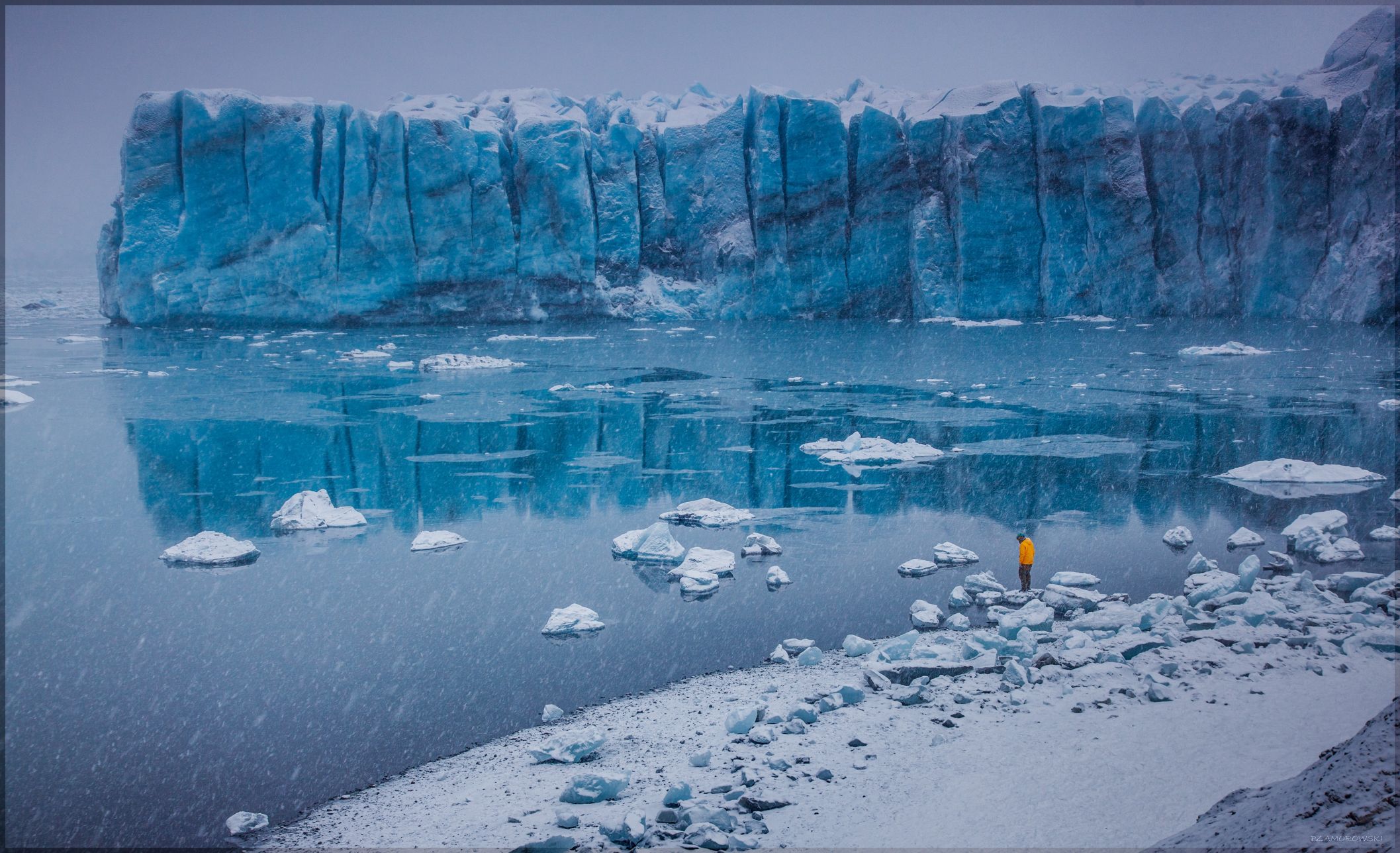
In the frostbitten heart of winter, the towering icy ramparts of Vatnajökull pose against the stark Icelandic sky. Its surreal blue facade, carved and sculpted by centuries of wind and weather, emanates an ethereal glow, a frozen titan in repose. This spectacle is made all the more poignant with the inclusion of a solitary figure, a tiny human silhouette swathed in a bright yellow jacket, forming a striking contrast against the backdrop of the colossal glacier.
The lone figure serves to emphasize the enormity and grandeur of the icy wilderness, adding scale to the landscape and evoking a sense of awe and insignificance. The contrast of the vibrant yellow against the icy blue of the glacier gives the scene an almost otherworldly feel. This interplay of color and scale captures the essence of travel photography: the merging of human curiosity with the imposing, often humbling, expanse of nature.
Photographing in Iceland’s rugged terrain, particularly in the harsh winter, can be a formidable challenge. The biting wind, the erratic weather, the relentless cold – all conspire to test the photographer’s resolve. And yet, as Ansel Adams once said, “A great photograph is one that fully expresses what one feels, in the deepest sense, about what is being photographed.” This belief resonates in the heart of the photographer who ventures into the icy wilderness, capturing not just images, but echoes of their emotional connection with the environment.
In Iceland, the drama of the elements is a spectacle that unfolds without respite. The skies are a theater of clouds and light, the land a primal arena shaped by the will of fire and ice. Amidst this wilderness, the photographer is not just a spectator, but a participant, capturing fleeting moments of magic that intertwine man, nature, and the passage of time.
As the indomitable Henri Cartier-Bresson asserted, “To photograph is to hold one’s breath when all faculties converge to capture fleeting reality.” This rings especially true in the heart of Iceland’s winter. Amidst the relentless elements, with the humbling Vatnajökull as a silent companion, each click of the shutter is a moment frozen in time, a whisper of the eternal struggle and harmony between man and nature.
Vatnajökull, the towering blue giant, and the solitary figure in yellow, against the unforgiving Icelandic winter, compose a narrative of insignificance and grandeur, struggle and tranquility, human spirit, and natural wonder. It’s a testament to the power of travel photography, in its ability to document, inspire, and tell stories, distilling the soul of a place into frames that echo with the symphony of existence, an eternal dance between the traveler, the lens, and the world.


